


 A first-hand account
What many business owners — especially in smaller trades or freelance operations — tend to underestimate is the security of their data. I was one of them, until the day I had the “great pleasure” of falling victim to a ransomware trojan. My entire computer was paralysed, and the worst part: all data was lost. Even the backups I had just created were unusable.
One morning I stared, stunned, at a message that took my breath away: “Your files are encrypted — pay …”.
That was the moment I realised my existing protection was completely inadequate. I had well-known antivirus software, but it was no help at all. Everything I had relied on failed completely.
Cybercrime: A growing, invisible monster
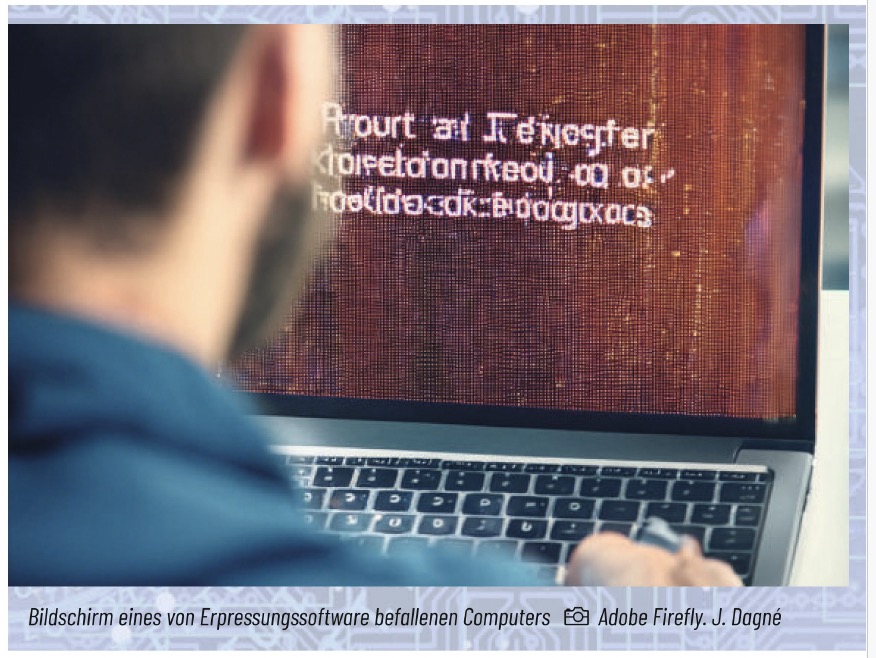 What happened to me is unfortunately no isolated case. Cybercrime is increasing dramatically worldwide, and more and more people and businesses are falling victim. Small and medium-sized enterprises in particular are being targeted, as they are often less well protected.
In 2023, cybercrime reached a record high. According to reports, attacks worldwide rose sharply, especially in the area of ransomware — extortion software that encrypts data and triggers ransom demands. Many businesses underestimate that they are the primary targets of these criminals.
The helplessness of the criminal police
The criminal police were also of limited help, though they were friendly and well-meaning. The officers knew the problem, but in my case it was impossible to catch the perpetrators or trace the attack. According to BKA statistics, the clear-up rate for cybercrime is only 32.2%.
The police explained to me that even after a payment, the probability of the data being decrypted is very low. This is down to several reasons:
- No interest: Cybercriminals often have no interest in releasing access after payment.
- Technical inability: Sometimes the perpetrators themselves are not able to decrypt the data.
- Fraudulent models: Some groups demand money repeatedly without ever intending to restore the data.
- Reputation is irrelevant: Unlike legitimate business partners, criminals operate without regard for their reputation.
- Anonymous payments: Criminals often demand payment in cryptocurrencies, making tracing almost impossible.
The recovery and my new approach
After the costly and time-consuming restoration of my systems, I was recommended Bitdefender. This antivirus software uses state-of-the-art anti-ransomware technology and automatically creates backup copies.
Since installing Bitdefender, I have had peaceful nights. The software immediately deletes suspicious emails or quarantines them before they can cause damage.
In addition, I have completely restructured my data setup:
- External NAS: My sensitive data now resides on its own encrypted server (NAS), accessible only to me.
- Multiple protection mechanisms:
- Versioning: An app maintains versioning with up to 10 previous states.
- Encrypted backups: An encrypted copy is created in a compressed file on an external USB drive.
- Raw data backup: As soon as a USB drive is connected, the raw data backup runs automatically.
These measures ensure that my data is not stored directly on the computer and is backed up multiple times. VPN connections allow me to access my data securely while on the move.
Conclusion: Security is essential!
 Cybercrime is a real threat, and no business is too small to be attacked. Thanks to Bitdefender and my new server structure, my data is now secure. My advice: protect your business!
Investments in security pay off before the damage occurs. Regular backups and multiple protection mechanisms are essential. Nothing is 100% secure, however, which is why it is advisable to rely on a trustworthy local administrator.
Background: Cybercrime in Germany
Cybercrime causes enormous economic damage every year. According to the industry association Bitkom e.V., the total economic damage caused in 2023 amounted to 148 billion euros. The clear-up rate rose by three percentage points and now stands at 32.2 per cent.
Good to know
- Wallets: Digital tools for online payments that store credit and debit cards.
- VPN (Virtual Private Network): An encrypted connection that enables secure access to networks.
- NAS (Network Attached Storage): A central file storage system accessible via a network.
Security aspects when using NAS:
- Access control: Only authorised users should have access. Strong passwords and two-factor authentication are essential.
- Regular backups: Implement a backup strategy such as the 3-2-1 rule.
- Encryption: Encrypt your data both at rest and during transmission.
- Firmware updates: Keep the NAS device’s firmware up to date.
- Network security: Use VPNs instead of port forwarding to prevent unauthorised access.